IEEE MASS 2025
DailyLLM: Context-Aware Activity Log Generation Using Multi-Modal Sensors and LLMs
University of California San Diego · Computer Science and Engineering


Abstract
Rich and context-aware activity logs facilitate user behavior analysis and health monitoring, making them a key research focus in ubiquitous computing. The remarkable semantic understanding and generation capabilities of Large Language Models (LLMs) have recently created new opportunities for activity log generation. However, existing methods continue to exhibit notable limitations in terms of accuracy, efficiency, and semantic richness.
To address these challenges, we propose DailyLLM. To the best of our knowledge, this is the first log generation and summarization system that comprehensively integrates contextual activity information across four dimensions: location, motion, environment, and physiology, using only sensors commonly available on smartphones and smartwatches.
To achieve this, DailyLLM introduces a lightweight LLM-based framework that integrates structured prompting with efficient feature extraction to enable high-level activity understanding. Extensive experiments demonstrate that DailyLLM outperforms state-of-the-art (SOTA) log generation methods and can be efficiently deployed on personal computers and Raspberry Pi. Utilizing only a 1.5B-parameter LLM model, DailyLLM achieves a 17% improvement in log generation BERTScore precision compared to the 70B-parameter SOTA baseline, while delivering nearly 10 times faster inference speed.
From Sensor Context to an Activity Log
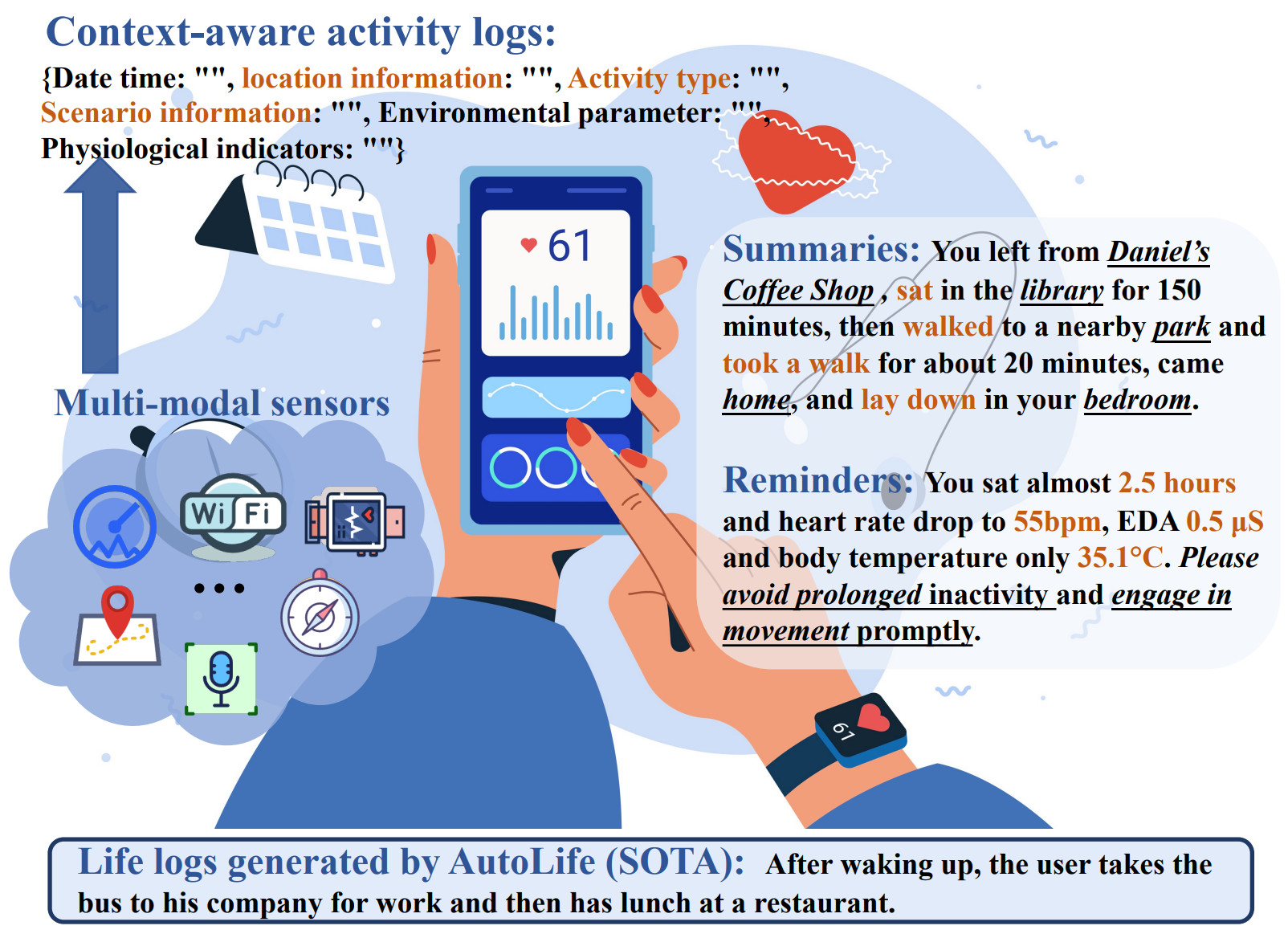
DailyLLM combines location, motion, environmental, and physiological context into a coherent timeline, following the user from a coffee shop and library to a park and back home.
Input
Sensor observations
- Location
- Daniel's Coffee Shop → library → nearby park → home
- Motion
- Sitting for 150 minutes → walking for about 20 minutes → lying down
- Environment
- Scene and ambient context from microphone, light, and temperature sensing
- Physiology
- Heart rate 55 bpm · EDA 0.5 μS · body temperature 35.1°C
System
DailyLLM
Extracted features + structured prompts + lightweight LLM
Output
Generated activity summary
“You left Daniel's Coffee Shop, sat in the library for 150 minutes, then walked to a nearby park and took a walk for about 20 minutes, came home, and lay down in your bedroom.”
Key Contributions
Context-rich activity understanding
To the best of our knowledge, DailyLLM is the first sensor-based system designed to automatically generate activity logs and summaries across four key dimensions: location, motion, environment, and physiology.
Constructed multimodal dataset
The project releases JSONL data for activity prediction, scene understanding, location description, and activity-log generation and summarization, supporting classification and natural-language generation research.
Lightweight and edge-ready design
Efficient feature extraction, structured prompting, and LoRA fine-tuning enable DailyLLM's 1.5B model to achieve 17% higher activity-log generation BERTScore precision than a SOTA approach using LLaMA3-70B, while delivering nearly 10× faster inference. The system is also evaluated on Raspberry Pi 5.
Released research resource
The DailyLLM Dataset
We construct and publicly release a multimodal dataset that connects sensor interpretation with context-aware language generation. It is organized as JSONL dialogues for four complementary task groups.
Task 01
Activity Prediction
Smartphone IMU features support activity classification across four public HAR benchmarks.
Task 02
Scene Understanding
Acoustic features support recognition across 15 everyday environmental scenes.
Task 03
Location Description
GPS and Wi-Fi context supports structured natural-language location descriptions.
Task 04
Logs and Summaries
Combined multimodal context supports activity-log generation and longer-term summarization.
System Overview
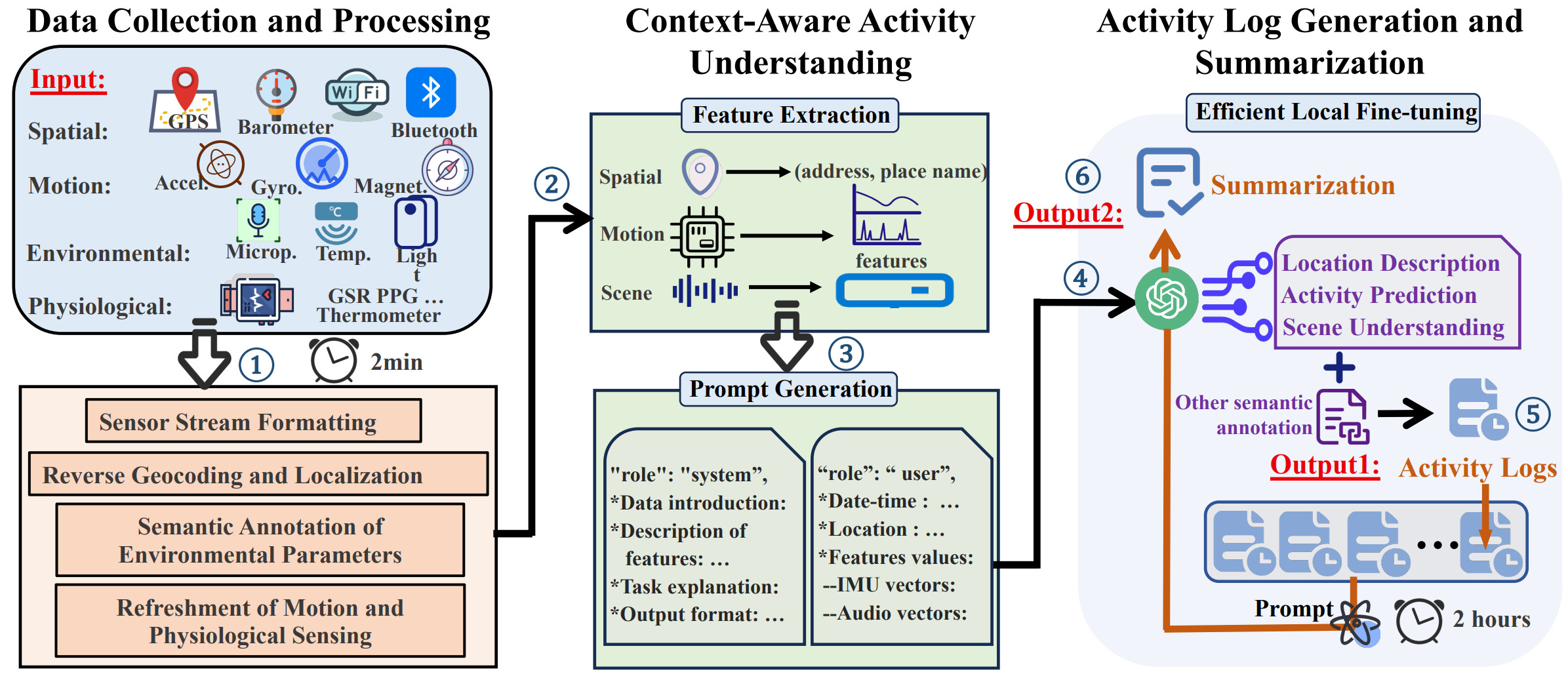
DailyLLM first aligns heterogeneous smartphone and wearable sensor streams and converts them into compact semantic features representing location, motion, environment, and physiology. Structured prompts combine those features with task and output guidance, enabling the locally fine-tuned LLM to generate fine-grained activity logs and higher-level summaries.
- 1Sensor data processingAlign streams, localize, and annotate context.
- 2Feature extractionCompress spatial, motion, scene, and physiological signals.
- 3Context understandingBuild structured prompts for the fine-tuned LLM.
- 4Logs and summariesGenerate activity records and periodic summaries.
Key Results
Compared with SOTA methods, DailyLLM achieves 17% higher activity-log generation BERTScore precision while delivering nearly 10× faster inference. On a resource-constrained Raspberry Pi 5, it can summarize two hours of activity data within four minutes. Together, the experiments demonstrate the practical effectiveness of DailyLLM for real-world activity logging.


Average inference time per sample
| Device | Activity prediction | Scene understanding | Log generation | Summarization |
|---|---|---|---|---|
| NVIDIA RTX 4090 24 GB | 0.08 s | 0.13 s | 2.22 s | 1.63 s |
| Raspberry Pi 5 ARM Cortex-A76, 8 GB | 37 s | 90 s | 180 s | 240 s |
Frequently Asked Questions
What is DailyLLM?
DailyLLM is a system for generating and summarizing context-aware activity logs from multimodal sensors commonly available on smartphones and smartwatches.
What sensors does DailyLLM use?
The paper organizes mobile and wearable sensing into spatial sensors such as GPS, barometer, Wi-Fi, and Bluetooth; motion sensors such as accelerometers, gyroscopes, and magnetometers; environmental sensors such as microphones, temperature, and light; and physiological sensors such as GSR, PPG, thermistors, and infrared sensors.
What does the DailyLLM Dataset contain?
The released JSONL dataset covers four task groups: activity prediction from smartphone IMU features, acoustic scene understanding from audio features, natural-language location description, and activity-log generation and summarization. It combines derived data from public benchmarks including UCI, HHAR, MotionSense, Shoaib, DCASE, and StudentLife.
What contextual information does DailyLLM capture?
DailyLLM captures four complementary context dimensions: location, motion, environment, and physiology.
Why use an LLM for activity logging?
DailyLLM uses an LLM to interpret compact, structured sensor features and turn them into coherent activity descriptions and higher-level summaries rather than isolated activity labels.
How large is the DailyLLM model?
The main DailyLLM configuration uses a 1.5B-parameter DeepSeek-R1-Distill-Qwen model with LoRA fine-tuning.
Can DailyLLM run on edge devices?
Yes. The paper evaluates DailyLLM on a Raspberry Pi 5 with 8 GB of memory and reports a four-minute runtime for summarizing a two-hour activity-log window.
How does DailyLLM compare with larger LLM baselines?
Against the reported SOTA log-generation approach using LLaMA3-70B, the 1.5B DailyLLM configuration reports BERTScore precision of 81.65% versus 65.0% and average PC log-generation latency of 2.22 seconds versus 22.09 seconds.
Where can I find the code and dataset?
The code is on GitHub, and the dataset is on Hugging Face.
Citation
Cite the official IEEE MASS 2025 publication.
@inproceedings{tian2025dailyllm,
  title     = {{DailyLLM}: Context-Aware Activity Log Generation Using Multi-Modal Sensors and {LLM}s},
  author    = {Tian, Ye and Ren, Xiaoyuan and Wang, Zihao and Gungor, Onat and Yu, Xiaofan and Rosing, Tajana},
  booktitle = {2025 IEEE 22nd International Conference on Mobile Ad-Hoc and Smart Systems (MASS)},
  pages     = {372--380},
  year      = {2025},
  publisher = {IEEE},
  doi       = {10.1109/MASS66014.2025.00060},
  url       = {https://doi.org/10.1109/MASS66014.2025.00060}
}